PASTAND PRESENT PROJECTS

Education : Mainstreaming of Vulnerable Children

Terre de Hommes 1988- 1999


Before the act for construction workers was passed, it was seen that children of construction workers did not go to school and there were no proper creches at the construction site.


Accordingly, “Terre de Hommes” (TDH), Germany supported a project of NIRMANA for four schools and four crèches, along with health care facilities to cover 80 children and 200 students. NIRMANA had been providing informal teaching support through full day teachers each in three colonies of Construction Workers since 1989. This helped education for 200 children and 80 crèche children ages 1 to 6 years.


This project had given valuable experience to NIRMANA. With the implementation of the 1996 Acts in Delhi, NIRMANA planned to utilize these welfare funds collected under these Acts for the crèche and important education services to cover the children of 8 lakh construction workers in Delhi.


Deepalaya-Reach India (2005-2007)


The objective of the project was to mainstream the drop-out students of Unorganised sector Workers though non-formal education. The non-formal school was run by NIRMANA with the support of Reach India – Deepalaya in different locations of Delhi such as Banuwal Nagar, Haiderpur, Narela and Tikri Khurd.. The work also resulted in ensuring benefits such as incentives for education from Delhi Welfare Board. Major achievements of the project:-


862 boys and 887 girls enrolled in NIRMANA’S Learning Centres.


  • Mainstreamed 803 children of which 400 were boys and remaining were girls.

  • 463 children attended remedial classes and 335 were found to be regular in class.

  • Healthcare - HIV Aids Awareness


    Delhi State Aids Control Society (DSACS) (2003-2014)


    The objectives of the project was to prevent and control STI / RTI / HIV / AIDS and facilitate migrant workers to register under Welfare Board and ensure benefits from the Board.


    This Project covered ten thousand migrant workers and in the second year it covered high risk groups for composite target intervention (Commercial sex workers, Injecting Drug Users and Men having sex with men). NIRMANA reached approx. 750-FSW; 250-MSM and 150-IDUs have been covered under this project. NIRMANA covered around 1000 female sex workers under the Targeted Intervention project.The organisation had successfully executed HIV/AIDS Prevention Project in North West Delhi.


    SARDI-FHI (2006-2009)


    The objectives of the project were to prevent reduce HIV / AIDS cases with the help of various testing and treatments. This project had covered migrant Nepali populations at three different locations in south Delhi, Okhla Industrial Area and Pahargunj. NIRMANA in collaboration with SARDI implemented this project in 10 sites of South-Delhi in the Basant Gaon, Nepali Camp, Kusumpur Pahadi, Munirka,, R.K. Puram Sector-4, Katwaria Sarai, Adhchini, Begumpur, Bersarai and Mahipalpur areas. It helped to reduce the spead of HIV infection and generate awareness across the community.


    Urban Poor


    Child Rights and You (CRY) (2006-2013)

    The objectives of the project were for the upliftment of transport workers, tribal domestic workers and construction workers children. In the project, NIRMANA was able to reach more than 1000 children of Unorganised Sector Workers for the mainstreaming in vaccination through health camps by primary hospitals. NIRMANA also provided benefits to 1500 Construction Workers through the registration process under Delhi Building & Other Construction workers Welfare Board with support of the project.


    UNDP (2005 – 2007)


    Child Rights and You (CRY) (2006-2013)

    Urban Poverty Alleviation project was designed by UNDP and implemented by Govt. of India through the National Institute of Urban Affairs. As a part of its NCR component, six resettlement colonies Bawana, Jahangirpuri, Madipur, Dakshinpuri, Kalyanpuri and NandNagari were identified by the Govt. of NCT of Delhi, especially by the department of social welfare under which NIRMANA worked at Bawana and Jahangirpuri, focusing on livelihood issues.

    NIRMANA targeted construction workers, ensuring their registration with the Delhi Building and Other Construction Workers Welfare Board. NIRMANA identified 2000 Construction Workers (1000 from each location) through base line survey and Participatory Learning Action. In addition to registration of these Construction Workers, NIRMANA followed all the schemes of social welfare department based on livelihood issues for weaker section as well as marginalized people of the society.


    Action-Aid India (2006-2010)


    The objective of the project was to implement the Construction Workers Acts, 1996 and advocacy for the enactment of Social Security Acts for the other Unorganised Sector Workers.

    With the support of Action-Aid India, NIRMANA was able to file the petition in Supreme Court for the implementation of Construction Workers Acts in all the States/UTs, develop a nation-wide campaign for the enactment of comprehensive legislation for Unorganised Sector Workers and Domestic Workers.

    Study on Construction Workers (2005-2007)


    NIRMANA collaborated with the International Labour Organization (ILO)-UNDP Project on a construction sector study which envisaged a pilot demonstration initiative in selected, low-income localities of Delhi. The project targeted self-employed, micro entrepreneurs, informal workers, petty contractors, and home-based workers. The project adopted a demand led approach and sought to assess the needs of the workers, and analyse and design a strategy for improving job quality and generating additional employment. In a nutshell the primary goal of the project was to devise a core strategy for realizing ILO’s goal of decent work.


    Sir Dorabji Tata Trust (2007)


    The grant for the campaign of social security and regulation of employment of Construction Workers. Domestic workers and ultimately all other segments of unorganised Sector Workers. It has been run by NIRMANA in East and North-East parts of Delhi for one year with support from Sir Dorabji Tata Trust since November 2007.

    With the support of the project NIRMANA was able to register1000 Construction workers with the Delhi Building & Other Construction Workers Welfare Board. 200 Construction worker children were supported with incentives for their education from Delhi Building & Other Construction Workers Welfare Board.

    Considering gender, this project has enabled NIRMANA to empower female workers by sharing information on rights awareness, building their skills through cadre training and empowering them to advocate for effective legislation.


    Mission Convergence: Delhi Govt (2008-2016)


    NIRMANA had worked with the support of Mission Convergence for the District Resource Centre (Monitoring all the grass root level NGOs, CBOs from 2008-2013, Gender Resource Centre (2008-2016) and Homeless Resource centre (2010-2012).

    The objectives of Mission Convergence were:-

  • Establish, manage, operate, maintain and facilitate the welfare programme throughout the NCT of Delhi for providing welfare services in an integrated manner to the under-privileged citizens in an efficient, transparent, convenient, friendly and cost effective manner.
  • Rationalize and streamline the implementation of the schemes related with social services.
  • Improve access of the poor to get the maximum benefits of the welfare schemes.
  • Promote women empowerment.
  • NIRMANA covered more than 3000 marginalised households in the North-East and North-West district of Delhi and provided different types of support such as linking them with government schemes, vocational training, medical support through health camp etc. NIRMANA also surveyed the homeless population residing in the major pocket of North-West areas, linked to them with census survey, provided identity card and Aadhar card.

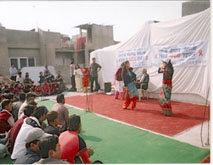
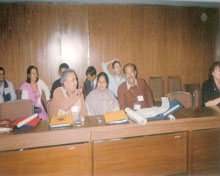
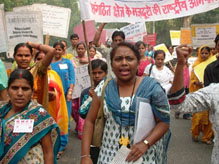
    Providing Benefits to Construction Workers


    Poorest Area Civil Society (PACS) (2013-2016)

    Poor execution and implementation of the existing schemes/Acts caused distress migration of the workers of the vulnerable districts of Madhya Pradesh, UP and Chhattisgarh. The objectives of the project was to ensure effective implementation of MGNREGA like registration, work and minimum wage and enrolment of MGNREGA workers under State Building & Other Construction Workers Welfare Board (through convergence), skill building of the MGNREGA workers to improve their earning capacities, social security to women MGNREGA workers and ensuring health benefits and entitlements to women (rural and urban) under the Janani Suraksha Yojna and the Rashtriya Swastya Bima Yojana (RSBY).

    NIRMANA covered 280 Gram Panchayats of 8 Block in 4 Districts of 3 States (Madhya Pradesh, Chhattisgarh and Uttar Pradesh) for the proper implementation above Social Security schemes and ensured the community to get all the entitlements.


    Domestic Works with Dignity


    Oak Foundation (2012-2016)

    A study was conducted in 2012 in Jharkhand and Delhi to comprehend the working condition of Domestic Workers . NIRMANA was part of that study wherein it was revealed that the tribal girls are migrating from their source state because there was no livelihood option for them there. The project had three ultimate goals of advocacy for social security to domestic workers through a comprehensive central legislation rehabilitate tribal girls who want to give-up domestic work into alternate occupations at source or destination areas and of providing healthy or safe route to migration to tribal girls who at present are being trafficked for domestic work.

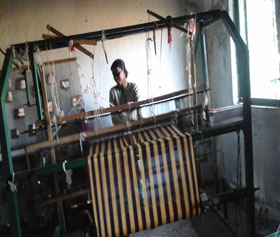
    Through the support of the project NIRMANA achieved to create a National Level network NGOs, CBOs, federations, activists, academia covering approx 12 States under the banner of NPDW (National Platform of Domestic Workers). NPDW drafted a Bill and submitted it in the both houses (Lok Sabha & Rajya Sabha) of Parliament in 2017 and the representatives of both houses introduced the Bill as private Members Bill). NIRMANA also trained more than 80 returnees Domestic Workers and potential migrant workers in Handloom training for stop the distress migration and trafficking. It also established three handloom weaving centres centered in the district of Gumla, Jharkhand