
Construction workers form an important part of India’s unorganised workforce. They contribute significantly to the development of buildings, roads, infrastructure and other essential facilities. However, many construction workers continue to face challenges relating to employment security, wages, workplace safety, housing, healthcare and access to social security.
Construction is one of the largest sources of employment for unorganised workers in India, with an estimated 44 million construction workers (NSSO, 2009-10). NIRMANA works for unorganised sector workers in general, with a specific focus on construction and domestic workers. Its work includes advocating for workers’ rights and ensuring that welfare provisions and existing legal protections reach workers on the ground.
Challenges Faced by Construction Workers
Construction work is often temporary and project-based. Workers frequently migrate from one construction site to another in search of employment, sometimes moving with their families.
Many construction workers and their families live in temporary settlements near work sites, often without adequate sanitation, clean drinking water, healthcare and other basic facilities.
Some of the major challenges include:
- Irregular employment and uncertain income.
- Migration between work sites and states.
- Inadequate housing and sanitation facilities.
- Occupational health and safety risks.
- Limited awareness of labour rights and welfare provisions.
- Difficulties accessing social security and government welfare schemes.
- Problems with registration and continuity of welfare benefits.
These challenges affect not only workers but also their families, particularly women and children.
Rights and Social Security of Construction Workers
Construction workers are entitled to protections and welfare measures under India’s labour framework. These provisions aim to improve working conditions, workplace safety and access to social security.
The Building and Other Construction Workers (BOCW) legislation of 1996 established an important framework for the welfare of construction workers. Its provisions have subsequently been subsumed into the Occupational Safety, Health and Working Conditions Code, 2020 and the Code on Social Security, 2020.
State Building and Other Construction Workers Welfare Boards have an important role in implementing welfare measures for eligible registered construction workers.
Depending on applicable provisions and eligibility, welfare measures may include:
- Life and disability benefits.
- Health and medical assistance.
- Maternity benefits.
- Educational assistance for workers’ children.
- Pension and insurance benefits.
- Skill development programmes.
- Housing and transit accommodation support.
- Awareness and access to welfare schemes.
Workers should check the latest eligibility requirements and application procedures with their respective State Welfare Board.
Building and Other Construction Workers Welfare Boards
State Building and Other Construction Workers Welfare Boards are responsible for administering welfare measures for eligible construction workers.
These Boards play an important role in worker registration, maintaining beneficiary records and facilitating access to applicable welfare schemes.
However, awareness of these provisions and effective implementation are essential. Workers need information about their entitlements and assistance in accessing the available welfare mechanisms.
Migrant Construction Workers and Their Families
Migration is a common feature of construction-sector employment. Workers often move across districts and states depending on the availability of work.
Frequent migration can create difficulties in maintaining employment records, completing registration procedures and accessing welfare benefits.
The needs of migrant construction workers must therefore be addressed through awareness, effective implementation of labour protections and improved access to social security.
Adequate housing, sanitation, healthcare, education for children and safe working conditions are also important for the well-being of migrant workers and their families.
NIRMANA’s Work for Construction Workers
NIRMANA works for unorganised sector workers in India, including construction workers and domestic workers. A key area of its work is to ensure that existing legislation and welfare provisions for construction workers are effectively implemented on the ground.
NIRMANA’s support to the National Campaign Committee for Construction Labour (NCC-CL) has been central to the enactment of the BOCW Acts of 1996 and to the Supreme Court’s monitoring of their implementation across States and Union Territories. Read more about our National Campaigns.
NIRMANA focuses on the importance of workers’ rights, social security and dignified livelihoods. It recognises that legal provisions can make a meaningful difference only when workers are aware of their rights and can access the benefits intended for them.
Through its work and advocacy, NIRMANA seeks to strengthen the implementation of welfare measures and improve the living and working conditions of unorganised workers.
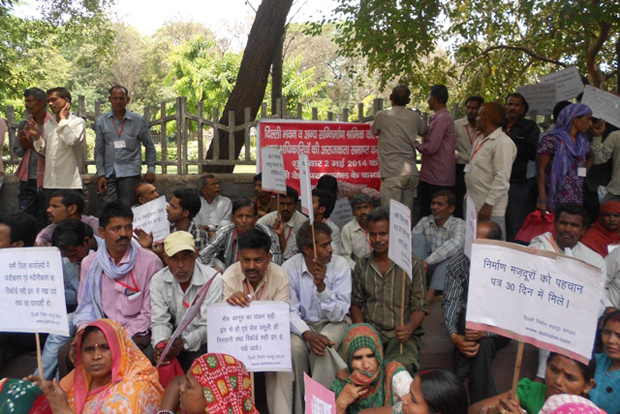
Rally of Construction Workers (2004)
Towards Dignified Livelihoods for Construction Workers
Construction workers contribute to India’s development and infrastructure. Their work and contribution deserve recognition, dignity and adequate social protection.
Effective implementation of labour protections, awareness of welfare schemes, access to social security and improved living conditions are essential to ensuring dignified livelihoods for construction workers and their families.
NIRMANA continues to work towards the rights, welfare and social security of unorganised workers in India.
Learn More About NIRMANA
- What We Do – NIRMANA’s programmes and areas of work.
- Know Us – our genesis, our work and the people behind it.
- Reports and Publications – studies, newsletters and other documents.
- Contact NIRMANA – our offices and how to write to us.